Glossary · Coined by Nodalist AI · 2026
What is AI Grounding?
AI Grounding is the deep-research method coined by Nodalist AI in 2026, where a plan-driven pipeline reads your canvas context, proposes a research plan for you to approve, searches the open web iteratively, evaluates every source it finds, and returns a fully cited report as a persistent, branchable canvas node — paired with a complete References Audit Ledger. AI Grounding is to research what AI Storming is to debate: the counterweight that anchors an idea in evidence instead of opinion.
Why “AI Grounding”?
The name draws a deliberate counterweight to Nodalist's other coined feature, AI Storming. Storming is upward chaotic exploration — six AI models debating one question, surfacing disagreements no single mind would see. Grounding is the downward deliberate verification — anchoring an idea in cited, evaluated, real-world evidence.
The two together form a complete cognitive system. Storm to find the right question. Ground to anchor the answer. Both produce artifacts that live on your canvas, connect to your other nodes, and become fuel for the rest of your thinking.
AI Grounding is to research what AI Storming is to debate — the counterweight that anchors an idea in evidence instead of opinion.
AI Grounding vs. grounding an AI model
“Grounding in AI” is a general idea before it’s a Nodalist feature. To ground an AI model is to tie its answers to real, checkable evidence instead of letting it generate from memory alone. An ungrounded model predicts the most plausible-sounding text; a grounded AI system retrieves source material first, then answers from it — which is what keeps the response honest and cuts down on hallucination.
Most grounding you’ve seen is shallow: a chatbot does a quick web grounding pass — one search, a few snippets stitched into the reply — and moves on. You can’t see which sources it used, which it ignored, or whether they actually support the claim.
Nodalist’s AI Grounding is the deep version of that same principle. It plans the research, searches the open web iteratively, evaluates every source for credibility, and shows its work in a References Audit Ledger — the sources it kept and the ones it discarded, with the reasoning attached. Same goal as grounding any AI model — answers anchored in evidence — taken from a one-shot snippet to an auditable research pipeline.
How AI Grounding works
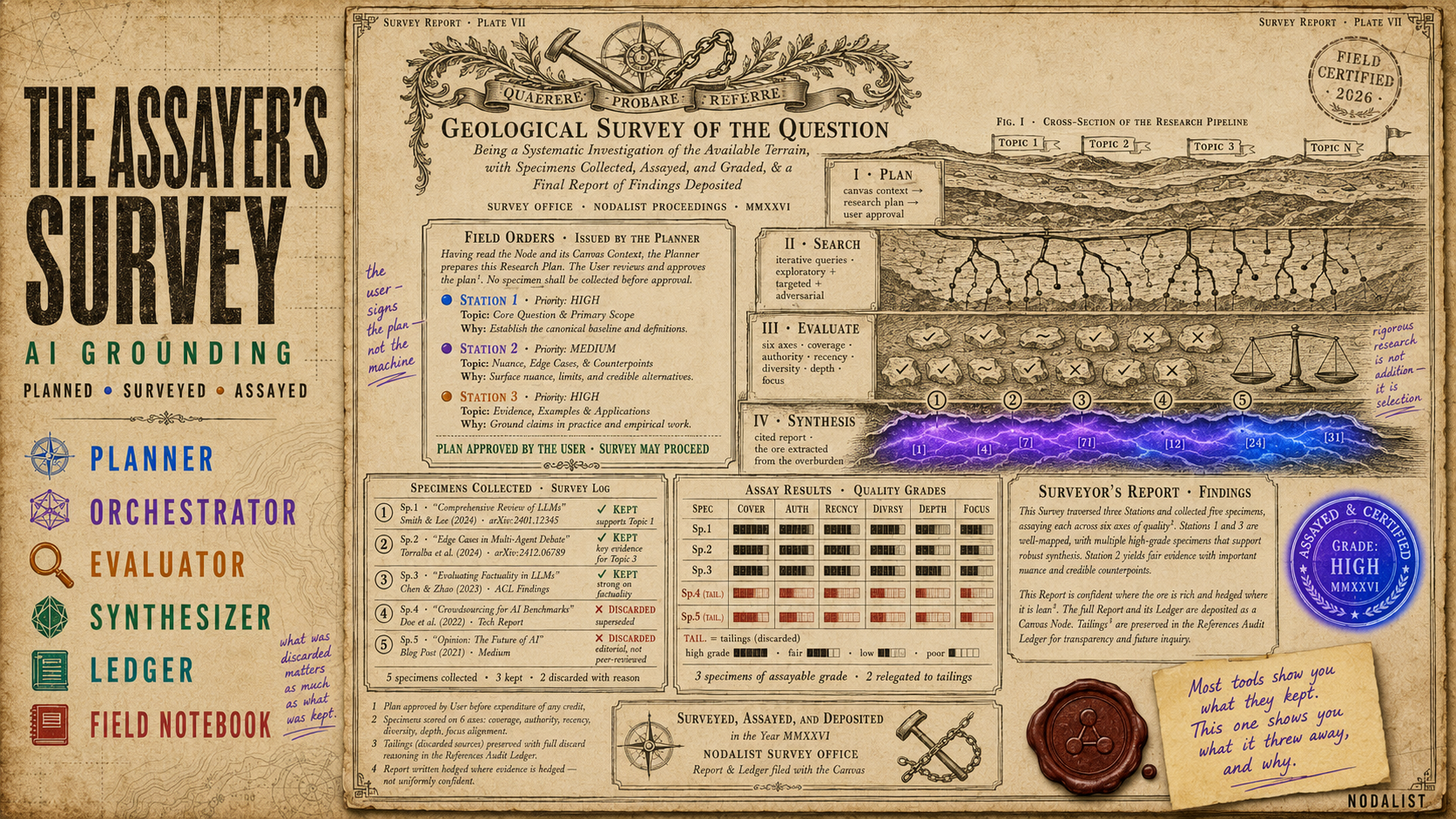
Every AI Grounding session runs through four named stages. Each stage has a clear job, a clear handoff, and a clear point at which you stay in control of the work.
01 Planner
The Planner reads the node you triggered AI Grounding on, plus its canvas context — the ancestor journey, connected files, prior decisions on the branch. It produces a list of research topics, each with a label, a description, a strategic why, and a priority. The Planner does not search the web; it decides what to investigate and how. You see the plan before any external work happens. Edit topics. Remove ones that don't fit. Add ones you specifically want covered. The plan only runs when you approve it.
02 Orchestrator
For each approved topic, the Orchestrator runs iterative web searches against the topic's strategic why. Each iteration generates a fresh set of queries — exploratory, targeted, adversarial — designed to surface evidence the previous iterations missed. Results are reranked against the topic's intent, the strongest ones kept, and the rest set aside with a reason. The Orchestrator decides when a topic is well-covered and stops iterating, so high-priority topics get more depth and narrow topics don't burn iterations they don't need.
03 Evaluator
When a topic's search phase ends, an independent Evaluator scores it along six structural axes — coverage, authority, recency, diversity, depth, and focus alignment. The Evaluator surfaces honest limitations: topics where evidence is thin, authority is contested, or recency is weak get flagged. Those flags travel forward with the topic so the final report can weight findings accordingly. Strong evidence gets strong treatment. Thin evidence gets a hedge, not a confident claim.
04 Synthesizer
The Synthesizer is the final stage. It reads your original focus, the approved plan, every kept source across every topic, the Evaluator's scores and flags, and writes the cited research report in your language. The report honors each topic's strategic why, weights findings according to evaluation scores, and writes hedged where the evidence is hedged. The output is the artifact — the thing you actually paid for and the thing that lands on your canvas.
And unlike ordinary deep research, the result does not vanish after one answer. It stays on your canvas as a living record you can reuse, branch from, and build on — ready to feed the next debate, the next branch, the next draft.
The References Audit Ledger
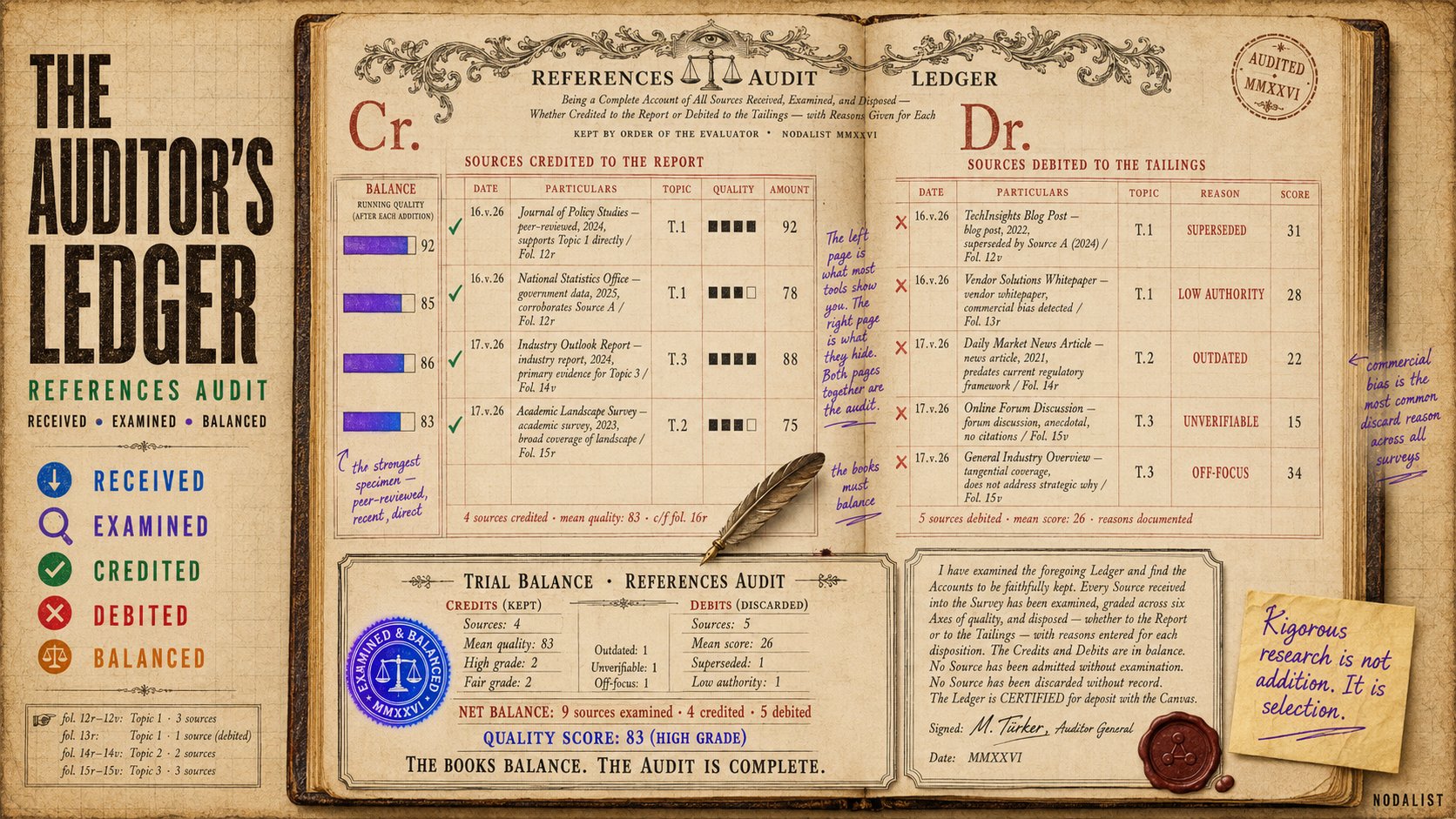
Most research tools show you what they kept. AI Grounding shows you what it discarded and why. Every source the pipeline considered is documented in the References Audit Ledger — organized per topic, with the kept ones (and the reasoning that put them in the report) above the fold and the discarded ones (with the reasoning that ruled them out) one click away.
This matters because rigorous research is not addition — it is selection. The quality of the report depends on the quality of the discard decisions just as much as on the inclusions. Hiding those decisions hides where the work actually happened. We show them on purpose.
The Ledger is viewable on the canvas node itself. It is also part of the PDF export, which lands with a Field Notebook cover page — classification line, generated timestamp, quality score, topic and source counts. The cover sets the document apart from a generic AI-generated page; the audit ledger inside sets the work apart from a black-box answer.
What makes AI Grounding different
Deep web research is becoming a commodity feature. AI Grounding's structural decisions stake out a different position inside that category.
Plan review before cost
You see and edit the research plan before a single credit is spent. The AI proposes; you decide. No surprises about scope, depth, or where the work is going. If the plan looks wrong, you fix it before the pipeline burns time and credits chasing the wrong questions.
Canvas-native artifact
The output is a node on your canvas, not a chat reply. You connect it to other nodes, branch from it, feed it into AI Storming as evidence the six debaters can reason against, or use it as ancestor context for your next AI generation. The research is part of the reasoning workspace, not an exit point you copy-paste from and lose track of.
Full source audit, kept and discarded
The References Audit Ledger shows every source the pipeline considered, including the ones it ruled out and the reasoning for the exclusion. You can verify the quality of the work without trusting a black box.
Honest evaluation, not confident hedging
A separate Evaluator agent scores every topic across six dimensions and flags the limitations the Synthesizer must honor. The final report writes confident where the evidence is confident and hedged where it is thin — instead of producing the fluent, evenly-graded prose that obscures uncertainty.
Field Notebook PDF export
Export the full report and audit as a PDF with a Field Notebook cover page — ochre classification line, botanical sprig divider, Newsreader serif typography, quality score, source counts, and a session ID. The document looks like a serious piece of work because it is one.
Pricing
AI Grounding is included in every Nodalist plan. Free-tier users get one AI Grounding session per 24-hour rolling window. Paid tiers have no daily limit. Each session costs credits based on plan size and topic count — you see the estimate before approving the plan, and no credit is deducted during plan review.
Free
$0 / month · 250 credits
1 AI Grounding session per day. Full canvas + AI Storming included.
Paid (from $5.99 / month)
Starter $5.99 · Pro $14.99 · Enterprise $99
No daily limit on AI Grounding. File upload, OCR, folder bundles, full export.
Frequently asked questions
What is AI Grounding?
AI Grounding is the deep-research method coined by Nodalist AI in 2026. It reads the context around a node on your canvas, plans a list of research topics for you to approve, searches the open web iteratively, evaluates every source, and returns a fully cited report as a persistent, branchable canvas node — paired with a complete References Audit Ledger of kept and discarded sources, both with reasons.
How is AI Grounding different from a typical 'Deep Research' button?
Three structural differences. First, plan review: AI Grounding shows you the research plan and lets you edit topics before any credit is spent. You decide what gets researched, not the AI. Second, the canvas-native artifact: the output lands as a persistent, citable, branchable node on your visual canvas — not a one-shot chat reply you copy-paste away. You can connect it to other nodes, branch from it, feed it into an AI Storming debate, or use it as context for another AI mode. Third, the References Audit Ledger: every source the pipeline considered is documented — both the ones it kept and the ones it discarded, with the reasoning attached. You can audit the research instead of trusting a black box.
What is the References Audit Ledger?
The References Audit Ledger is the per-topic record of every source AI Grounding considered. For each topic, the ledger shows the queries that were run, the sources that were kept (with the reasoning for inclusion), and the sources that were discarded (with the reasoning for exclusion). The ledger is viewable inside the canvas node and is exported as part of the PDF with a Field Notebook cover page. It exists because research you can't audit isn't research — it's a black box.
Why is it called 'AI Grounding'?
The name draws a deliberate counterweight to Nodalist's other coined feature, AI Storming. Storming is upward chaotic exploration — six AI models debating one question. Grounding is downward deliberate verification — anchoring an idea in cited, evaluated, real-world evidence. The two together form a complete cognitive system: storm to find the right question, ground to anchor the answer. The category descriptor we pair it with for SEO is 'deep research' — but the brand is AI Grounding because the work isn't just searching, it's verifying and anchoring.
What languages does AI Grounding support?
AI Grounding detects the language of your question and writes the final report in that language. Search queries can run in different languages where the evidence warrants — Turkish historical research may pull from Turkish-language sources; technical machine-learning research may pull from English-language sources, even for a Turkish-speaking user. The report itself is always written in the user's language.
How much does AI Grounding cost?
AI Grounding is included in every Nodalist plan, including the Free tier. Free-tier users can run one AI Grounding session per 24 hours. Paid tiers (Starter $5.99/mo, Pro $14.99/mo, Enterprise $99/mo) have no daily limit. Each session costs credits depending on plan size and topic count — you see the credit estimate before approving the plan, and no credit is spent during plan review. Upgrade, downgrade, or top up anytime.
Can I use AI Grounding's output in other features?
Yes — that is the point of making the output a canvas node. Connect an AI Grounding node to another SmartNode and the next AI generation will see the grounded evidence as context. Branch from it and the next research session anchors to the same foundation. Feed it into AI Storming and the six debating models each see the cited evidence the panel is debating against. The artifact is not the end of the work; it is fuel for the rest of your thinking.
Can AI Grounding replace a researcher?
No. AI Grounding produces a structured, cited research artifact — but it does not replace human judgement, domain expertise, or the kind of investigation that requires interviewing people, reading primary documents in archives, or running original analysis. Frame it as a thinking partner that gets you to the right questions faster and shows its work along the way. The right consumer is someone who would have spent the next four hours opening browser tabs anyway.
Further reading
- Agentic Deep Research: What It Is and How It Works — the category-definition reference: what agentic deep research means, the five stages, who uses it, and what to look for in a tool.
- AI Research Tool: What to Look For — practical buyer's guide: the five levels of AI research quality, real scenarios, evaluation criteria.
- AI Storming — the upward counterweight: six AI models debating one question until they reach consensus.
- All features — the visual canvas, three thinking modes, folder bundles, journey export.
- Pricing — how credits work, what each plan includes, top-up packs.
- About Nodalist — what drives the product, who builds it.
Some things are too important to just chat about.
Free to start. No credit card required.
Start building your workspace