Definitional reference · Updated July 2, 2026
Multi-LLM debate explained, with the research
Multi-LLM debate is the protocol where two or more independently-built large language models exchange responses on the same prompt across multiple rounds — seeing each other's reasoning, rebutting, refining, and converging. This page is the definitional reference: what the category means, why it works (with the peer-reviewed research), and how Nodalist's AI Storming implements the protocol.
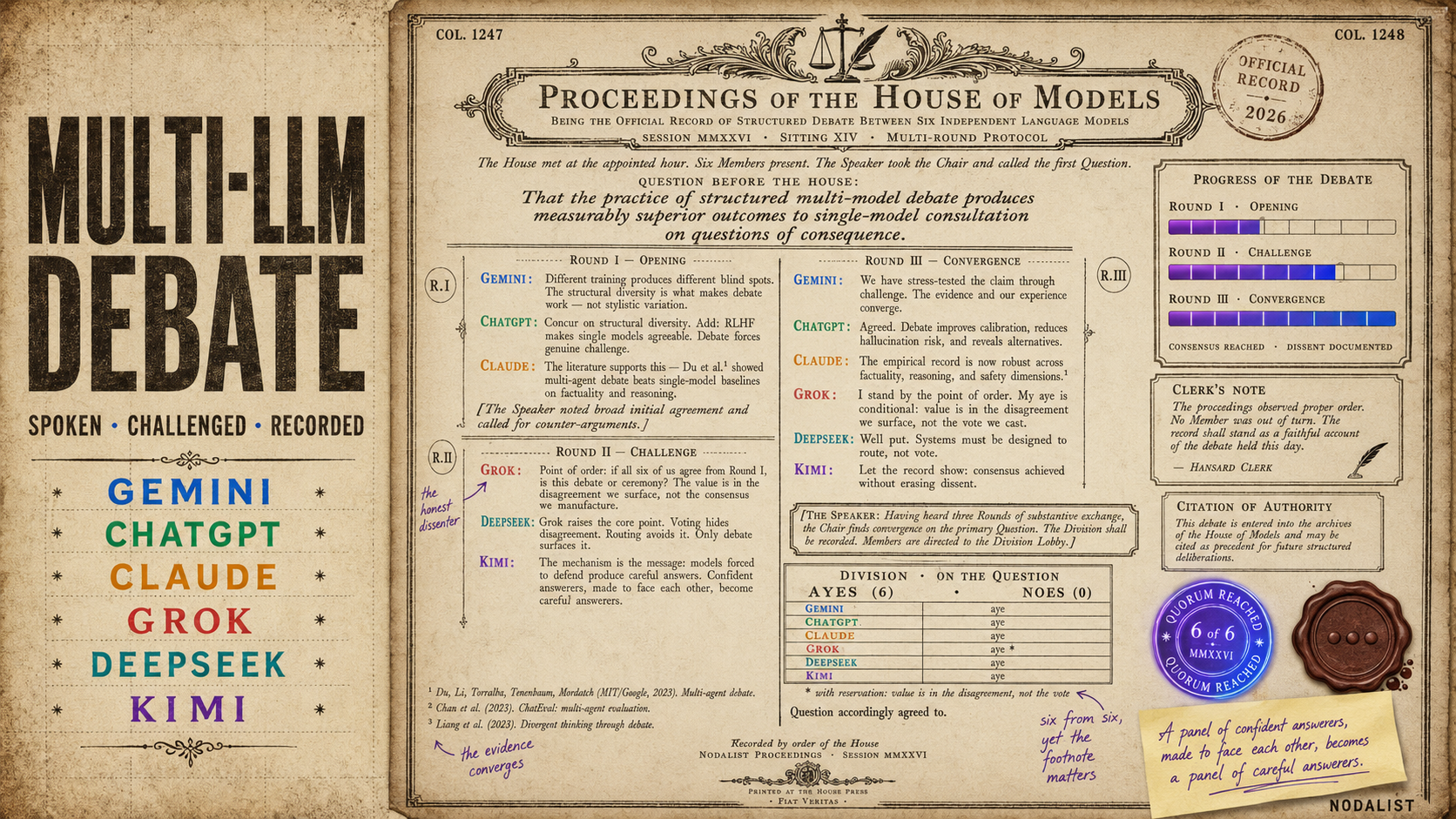
What multi-LLM debate is — and isn't
The category gets confused with three adjacent things. Clarifying the boundaries is worth doing once.
It is: structured cross-talk between models
Each model sees the previous round's responses, has the option to rebut, refine, or change position, and explicitly addresses points raised by others. The output captures both the converged answer and the disagreements en route to it. The structure — rounds, moderation, attribution — is what separates this from chaotic group-chat.
It isn't: model comparison
Side-by-side platforms run the same prompt against multiple models in parallel and let you read the responses next to each other. There's no cross-talk, no rebuttal, no convergence. Useful for evaluation; not multi-LLM debate.
It isn't: model routing
Routing systems pick the single best model per query based on prompt characteristics or cost. Only one model answers. The opposite of debate — the goal is to dodge the multi-model question entirely.
It isn't: ensemble voting
Voting runs N models in parallel and aggregates outputs by majority, weighting, or self-consistency. Disagreement is hidden inside the average. Useful for some classification tasks; misses the entire point of debate, which is to surface and reason through disagreement, not bury it.
Why multiple LLMs beat one
Three independent reasons, in order of how strong the evidence is.
1. Different training, different blind spots
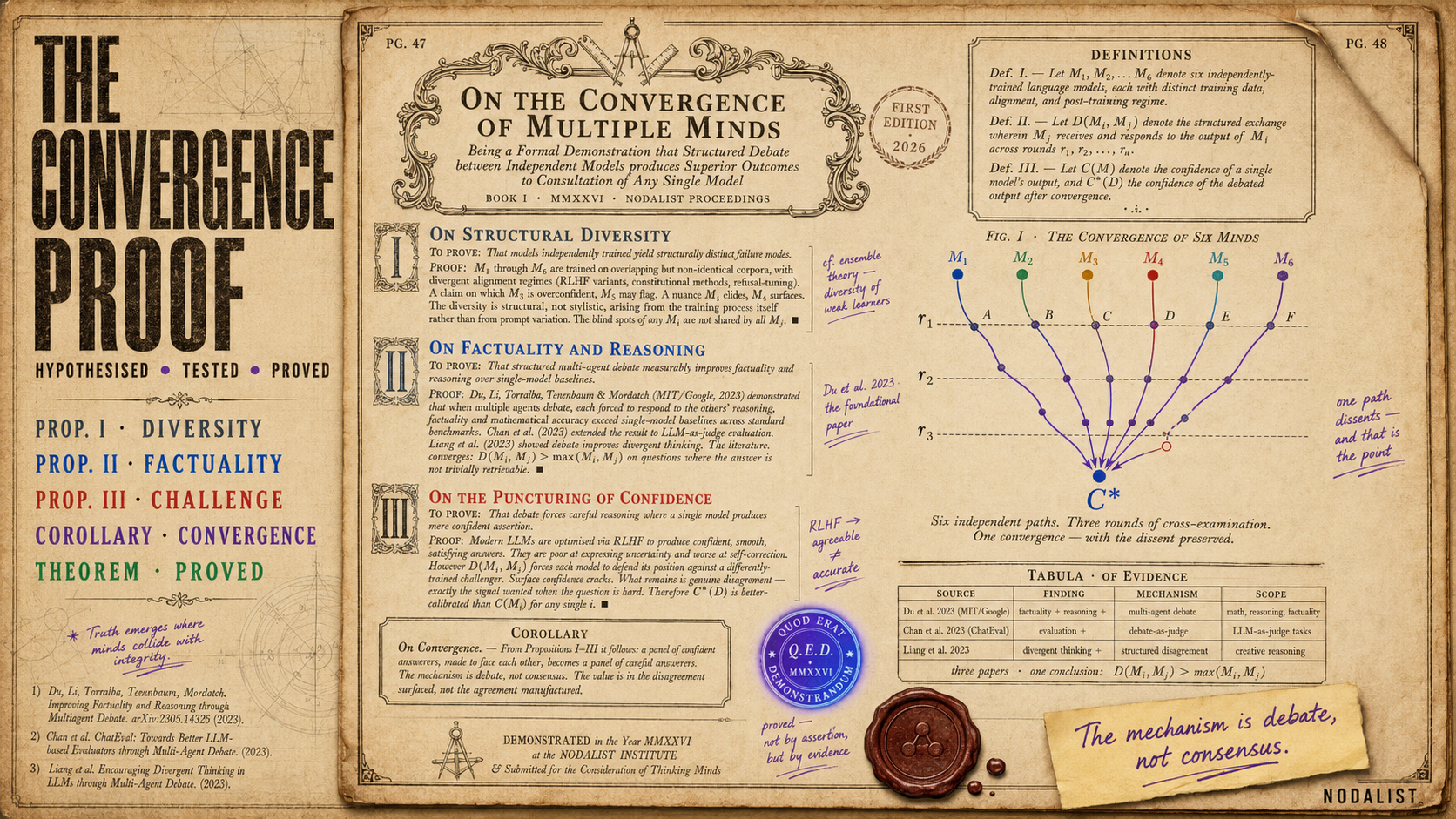
Today's frontier LLMs were trained on overlapping but non-identical data, with different post-training regimes (RLHF variants, constitutional methods, refusal-tuning). They don't fail in the same places. A claim that one model is overconfident on, another may catch. A nuance one misses, another surfaces. The diversity is structural, not stylistic.
2. Peer-reviewed evidence: debate improves factuality and reasoning
The foundational paper is Du, Li, Torralba, Tenenbaum, and Mordatch (MIT/Google, 2023) — Improving Factuality and Reasoning in Language Models through Multiagent Debate. They showed multi-agent debate beat single-model baselines on standard reasoning, math, and factuality benchmarks. The improvement scaled with model count up to a point, then plateaued.
Followups extended the result: ChatEval (Chan et al., 2023) applied debate to LLM-as-judge evaluation; Liang et al. (2023) studied debate's effect on divergent thinking. The literature is converging on a consensus: structured cross-model debate produces measurably better outputs than any single model in isolation, on the kinds of questions where the answer isn't trivially retrievable.
A note on scope: "multi-LLM debate" names both an active academic research area — the multiagent-debate literature above — and a practical tool category; this page covers both the research lineage and what the protocol means as a working product.
3. Single models are confident and agreeable. Debate punctures both.
Modern LLMs are RLHF'd to give confident, smooth, satisfying answers. They're bad at saying "I'm not sure" and worse at saying "you're wrong." Put two of them in a room and force them to defend their answers, and the surface confidence cracks. What's left is genuine disagreement, which is exactly the signal you want when the question is hard.
A panel of confident answerers, made to face each other, becomes a panel of careful answerers. That's not a stylistic preference — it's a structural one. The mechanism is debate, not consensus.
How Nodalist implements multi-LLM debate
Nodalist's implementation is called AI Storming. The protocol is straight from the research — multi-round structured debate with a designated moderator and a per-model-attributed consensus report. What's different is where it lives.
AI Storming is built into Nodalist's visual reasoning workspace. You launch it from any node on your canvas, and the debate inherits your full context: the question on the launching node, the ancestor branch you've already built, your connected files, the decisions made upstream. The debate itself runs in a dedicated debate room — chat-like in feel, but with rounds, named participants, and a moderator. Six top AI models speak as themselves: Gemini, ChatGPT, Claude, Grok, DeepSeek, Kimi — the exact models on the panel, and their published benchmarks, are listed here.
You can run more rounds, ask the moderator to check consensus, or interject your own steer between rounds. After consensus (or honest non-consensus), the structured report lands back on your canvas as a node attached to where you launched from. You keep working from there. The debate doesn't sit in isolation — it's a reasoning move inside a larger workspace, and the workspace is what makes the debate informed in the first place.
Free to start (250 credits/month). $14.99/mo Pro for sustained use.
A second opinion from AI — from models that actually disagree
Anyone who has pushed a hard question through a long AI conversation knows the pattern. The model holds its position for a message or two, then goes wherever you point it. Push back and it folds; rephrase the question and it agrees with the new framing too. That agreeableness is trained in — a single model is optimized to be satisfying, which makes it a poor source of a second opinion. When the question matters, you don't need a yes-man. You need a real opinion.
The obvious fix is to ask multiple AI models at once. But running the same prompt across several models in parallel only gets you parallel monologues — a row of confident answers that never see each other, with the disagreements left for you to find and adjudicate on your own. Comparison shows you where models differ; it doesn't make them work the difference out.
A moderated multi-LLM debate is engineered disagreement — the way you make AI disagree productively, on the record, about your actual question. Each model sees what the others said and rebuts, refines, or concedes across rounds. No single model gets to dominate the answer. If one model misses something, another can challenge it. If one goes too far, another can pull it back. In a real debate, the models stop acting like a single voice and start showing their strengths.
That is what AI Storming delivers: a per-model-attributed consensus report with the disagreements preserved rather than smoothed over — the closest thing to a genuine second opinion an AI system can give you today. And if you're weighing this category of tool more broadly, the AI consensus tool page covers what to look for.
Frequently asked questions
What is multi-LLM debate?
Multi-LLM debate is a protocol where two or more independently-built large language models exchange responses on the same prompt across multiple rounds, see each other's reasoning, rebut, refine, and converge. The output is one no single model would have produced alone. It's distinct from model comparison (parallel responses, no cross-talk), model routing (picking one model per query), and ensemble voting (averaging outputs without debate).
Why use multiple LLMs instead of just the best one?
Independent training data, alignment regimes, and reasoning patterns produce different blind spots. A 2023 MIT/Google paper (Du et al.) showed multi-agent debate improves factual accuracy and reasoning over single-model baselines on standard benchmarks. Single models tend to be confident and agreeable; debate forces models to defend, rebut, and revise — surfacing disagreements that signal genuine uncertainty rather than glossed-over confidence.
Is multi-LLM debate the same as ensemble voting?
No. Ensemble voting runs models in parallel and aggregates outputs by majority or weighting. Multi-LLM debate runs models sequentially across rounds where each model sees the previous round's responses and explicitly addresses them. Voting hides disagreement under the average; debate surfaces it as input.
How many AI models do you need for a useful debate?
Research suggests a meaningful improvement over single-model baselines starts at 3 models (Du et al. 2023). Diminishing returns appear around 5–7 models depending on prompt type. More models means more compute cost and longer wall-clock time per debate, with smaller incremental quality lift.
Which is better — multi-LLM debate or just asking one frontier model directly?
It depends on stakes. For everyday questions, a single frontier model is faster, cheaper, and usually sufficient. For high-stakes decisions (strategy, large purchases, technical architecture, contested questions), multi-LLM debate surfaces disagreements and blind spots that any single model would smooth over. The decision rule: if you'd want a second opinion from another expert, you probably want a multi-LLM debate.
How does Nodalist implement multi-LLM debate?
Nodalist's implementation is called AI Storming. Six top AI models (Gemini, ChatGPT, Claude, Grok, DeepSeek, Kimi) debate one prompt across rounds with a designated moderator. Sessions support multi-round iteration and user steering. Each session ends with a structured per-model-attributed consensus report. AI Storming is built into Nodalist's visual reasoning workspace, so the debate inherits context from your earlier work and the consensus returns to your canvas as a node you can keep working from.
Further reading
- What is AI Storming? — the full reference for Nodalist's implementation: six-model roster, moderator role, consensus phase, real session walkthrough.
- The AI models behind AI Storming — the current six-model roster, each vendor's published benchmarks with sources, and what changes once the models can see each other.
- AI consensus tool — what it is and what to look for — the demand-side landing: criteria for a serious consensus tool, how Nodalist's works, and pricing.
- The AI yes-man problem, explained — why a single model will eventually agree with you, why prompting it to be critical fails, and why disagreement has to be engineered.
- Improving Factuality and Reasoning in Language Models through Multiagent Debate — Du, Li, Torralba, Tenenbaum, Mordatch (MIT/Google, 2023). The foundational paper.
- ChatEval: Towards Better LLM-based Evaluators through Multi-Agent Debate — Chan et al. (2023). Debate applied to LLM-as-judge evaluation.
- Encouraging Divergent Thinking in Large Language Models through Multi-Agent Debate — Liang et al. (2023). Debate's effect on creative reasoning.
- Nodalist Features — the rest of the visual reasoning workspace that AI Storming is part of.
Try multi-LLM debate inside a visual reasoning workspace
AI Storming is the multi-LLM debate capability inside Nodalist, a visual reasoning workspace. The debate inherits your context — files, earlier decisions, ancestor branch — and the consensus returns to your canvas as a node you can keep working from. Free to start.
Try AI Storming free