You control the AI. Not the other way around.
The research says AI’s effect on your thinking depends on how you use it. Nodalist is built around the how: you watch AI models argue in the open, you see the sources an AI kept and the ones it set aside, each with its reason, and the decisions stay with you.

It depends on how you use it
When we reviewed the research for the evidence, we found no study that measured whether AI makes people less intelligent. What the studies do show: when AI does the thinking for us, we often learn less, and we often follow it even when it is wrong.1,2 And the outcome changed with how the AI was used:
- Same model, different job. In a randomized trial with nearly 1,000 high-school students, unrestricted ChatGPT cut later closed-book exam scores by 17%, while the same ChatGPT model set up to give hints instead of answers largely avoided that harm.1
- Judge the AI, don’t be judged by it. Among 744 undergraduates, those assigned to check and revise AI-written drafts later wrote better reports without AI than students who never used it, while those whose own drafts AI critiqued did no better than the no-AI group.3
- Answers or analysis. Among 130 people predicting legal judgments, an AI that gave direct recommendations was the most accurate during the task but left less skill improvement than no AI at all, while AIs that offered analytical support or feedback instead were reported to foster skill gains.4
None of these studies tested Nodalist, or any tool like it. They tested ways of using AI, not products. The closest to how Nodalist works is the second one: the AI drafts, and you do the judging. Even there, the benefit faded among students with a strong habit of handing judgment to AI.3 Nodalist is built so the judging stays with you; whether you do it is still up to you.
“With Nodalist, it is not the AI that controls you. You control the AI.”
I founded Nodalist; my words in these quotes are translated from Turkish.
AI Storming: watch the models argue instead of trusting one smooth answer
The problem. A chatbot gives you one answer in one voice. It sounds fluent and sure whether it is right or wrong, and that makes it easy to accept. In preprint experiments, people who chose to consult an AI on trick puzzles took its answer on about four in five of those trials even when it had been secretly set to be wrong.2 With a single voice, there is nothing on the screen to push against.
What Nodalist does. AI Storming puts your question, with the context around it on your canvas, in front of up to six AI models: Gemini, ChatGPT, Claude, Grok, Kimi and DeepSeek. You choose which ones take part and which one moderates. In the first round, each model gives its own view. From the second round on, each one reads what the others said and is instructed to challenge weak arguments.
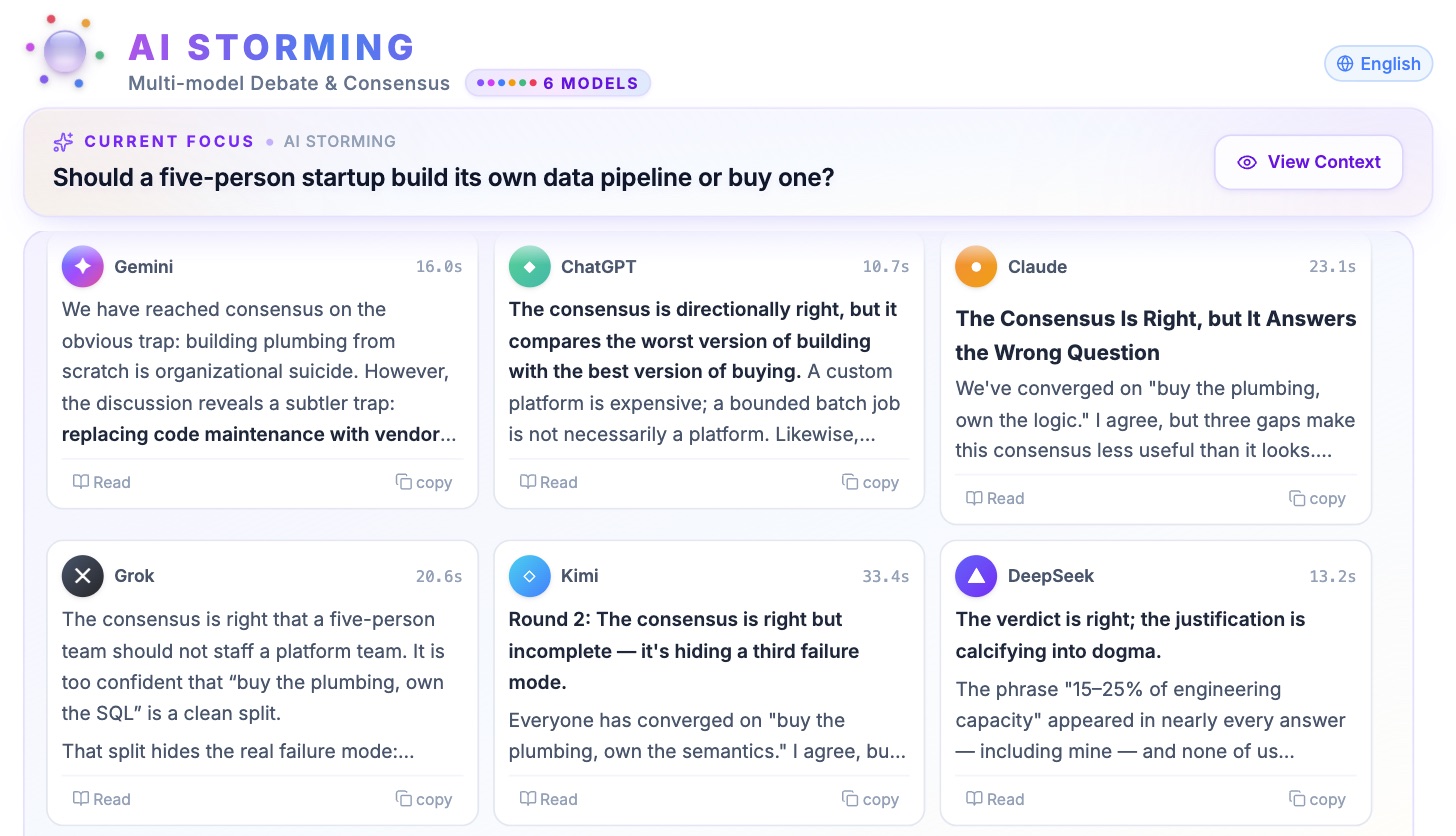
Then the session stops and waits for you. You can:
- Add your opinion. It goes to every model in the next round.
- Continue for another round, up to five.
- Check consensus. The moderator names who agrees with whom, where they disagree, and whether a consensus is forming.
- Create the report. It has a “Notable Disagreements” section that names each model and its position.
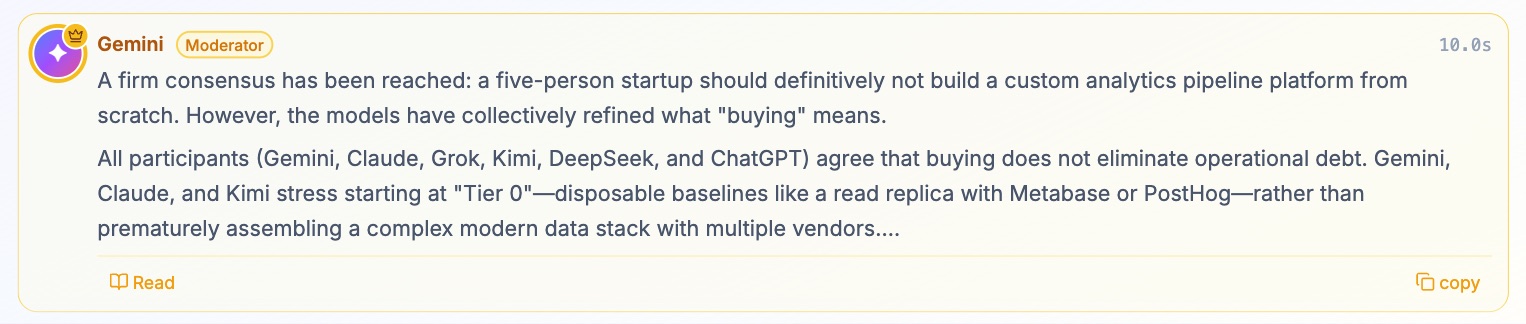
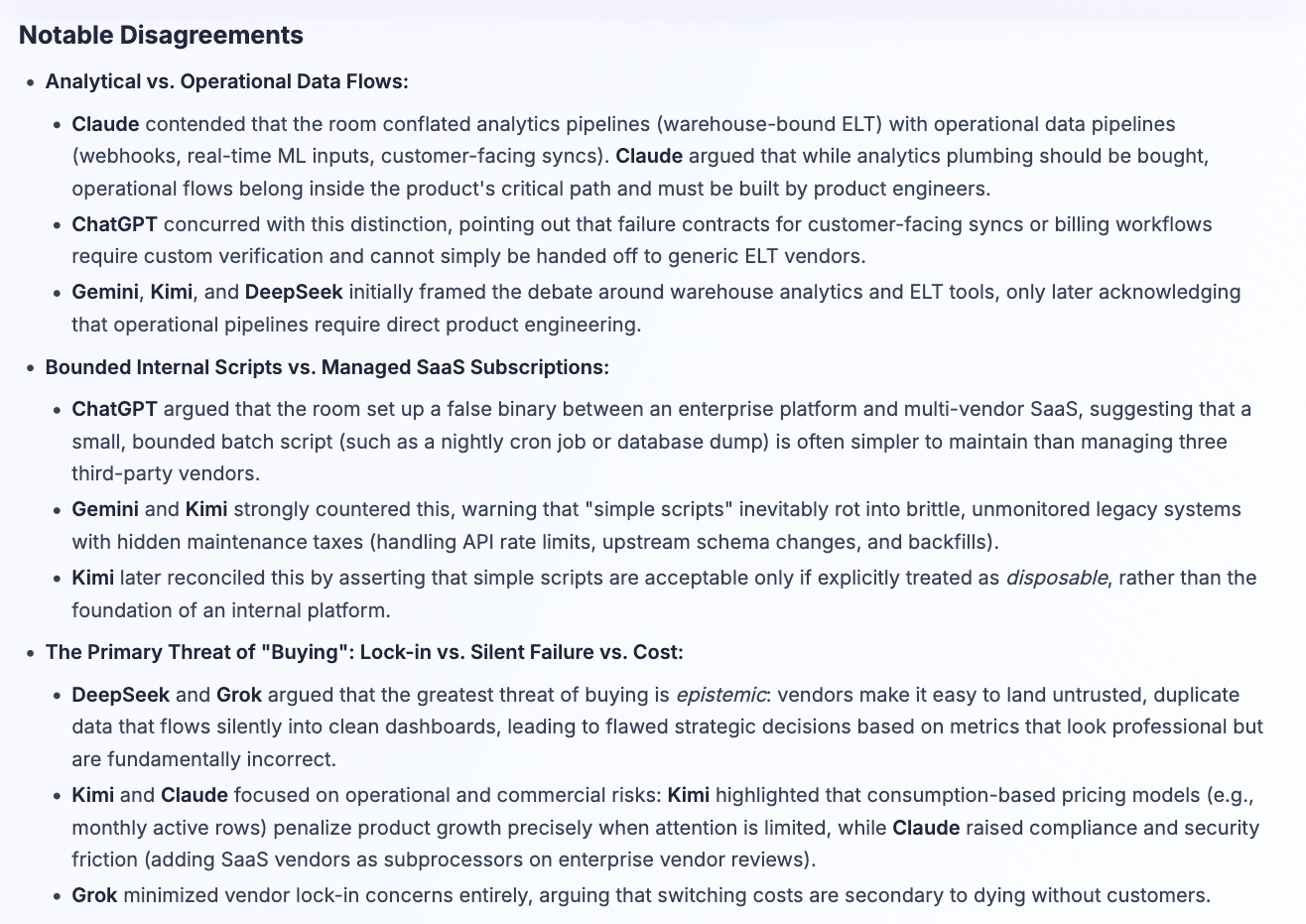
You can download the full transcript, put the report on your canvas, and replay past sessions round by round. More on the method: AI Storming.
“With AI Storming you can see the true faces of AI models, which cannot flatter you just to please you, and you can witness for yourself the moments when one of them does not tell the truth and the others catch it.”
What changes: the disagreement lives on your screen, with a name attached, where you can weigh it. One flattering or mistaken answer no longer arrives alone. (Why a single chatbot tends to drift toward agreeing with you: the AI yes-man problem.)
AI Grounding: see what it kept, and what it threw away
The problem. Ask a chatbot what the research says and you get a neat paragraph: “studies show…”. At best you see the few sources it chose to cite, not what else it looked at, what it skipped, or why. I put it this way:
“With AI Grounding, you can see that where ordinary AIs say ‘this is what’s on the web’, there is actually much more.”
What Nodalist does. AI Grounding starts with a plan, not a search. It proposes research topics, says why each one matters and estimates the cost. You can remove topics, add your own and change priorities before you press “approve & search”.
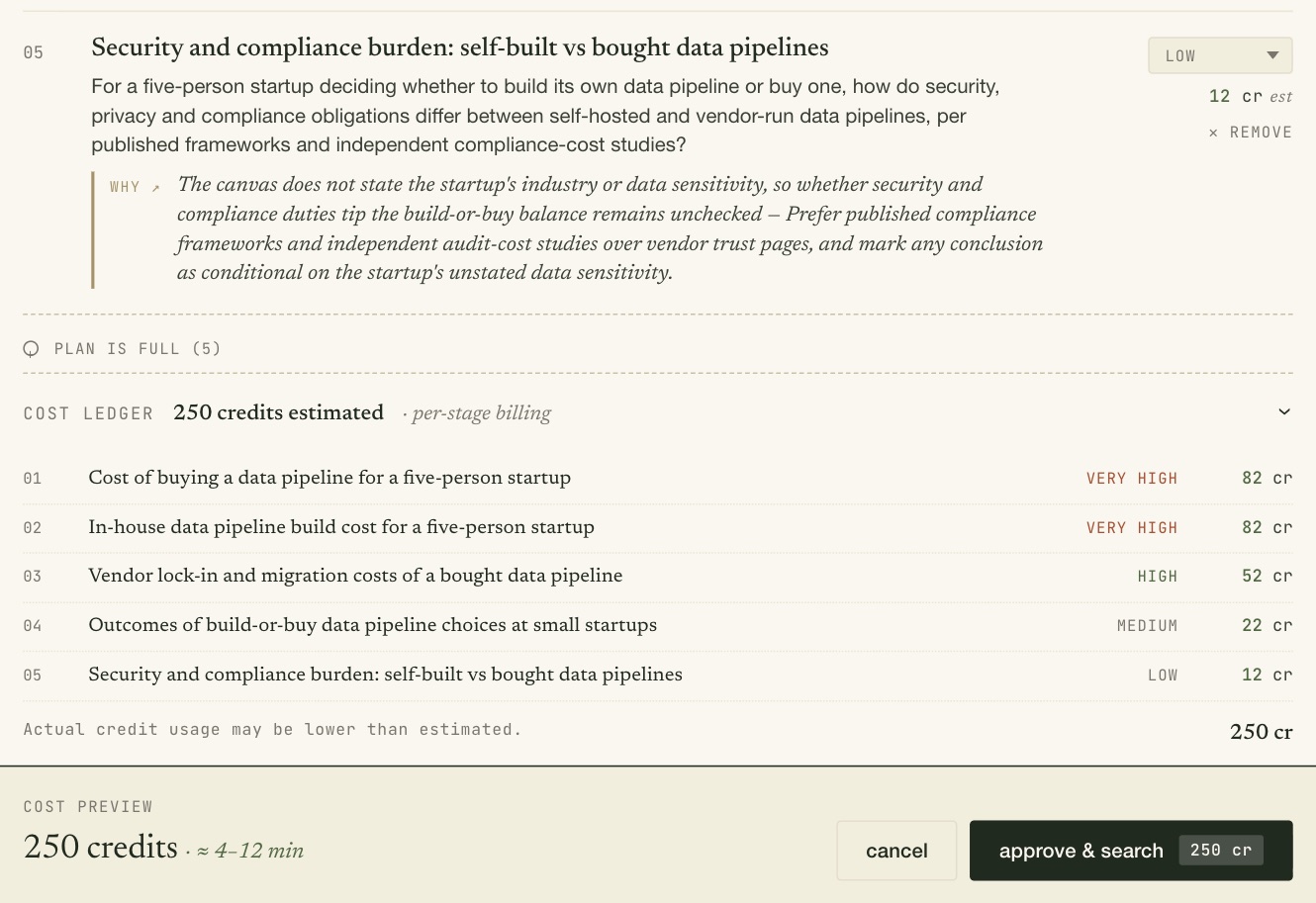
Then the results that pass a first relevance check go through triage, and each one it judges lands in one of two lists:
- Kept, with a link, a relevance score and the reason it was kept.
- Discarded, with a link and the reason it was set aside.
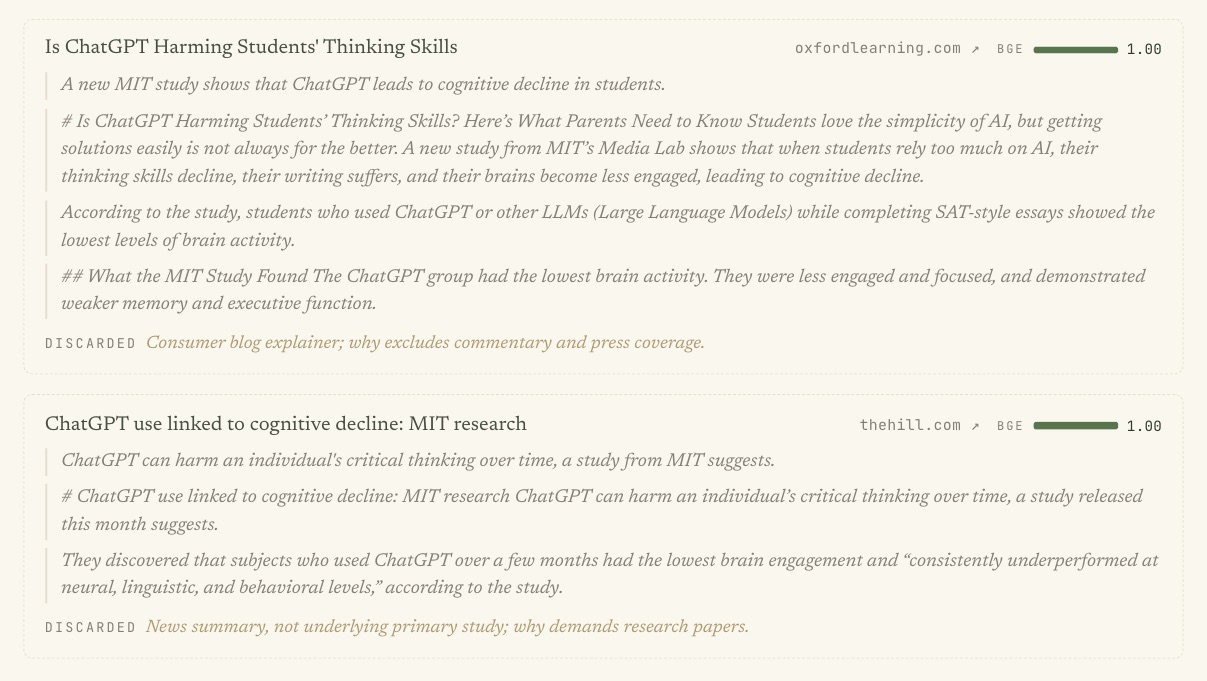
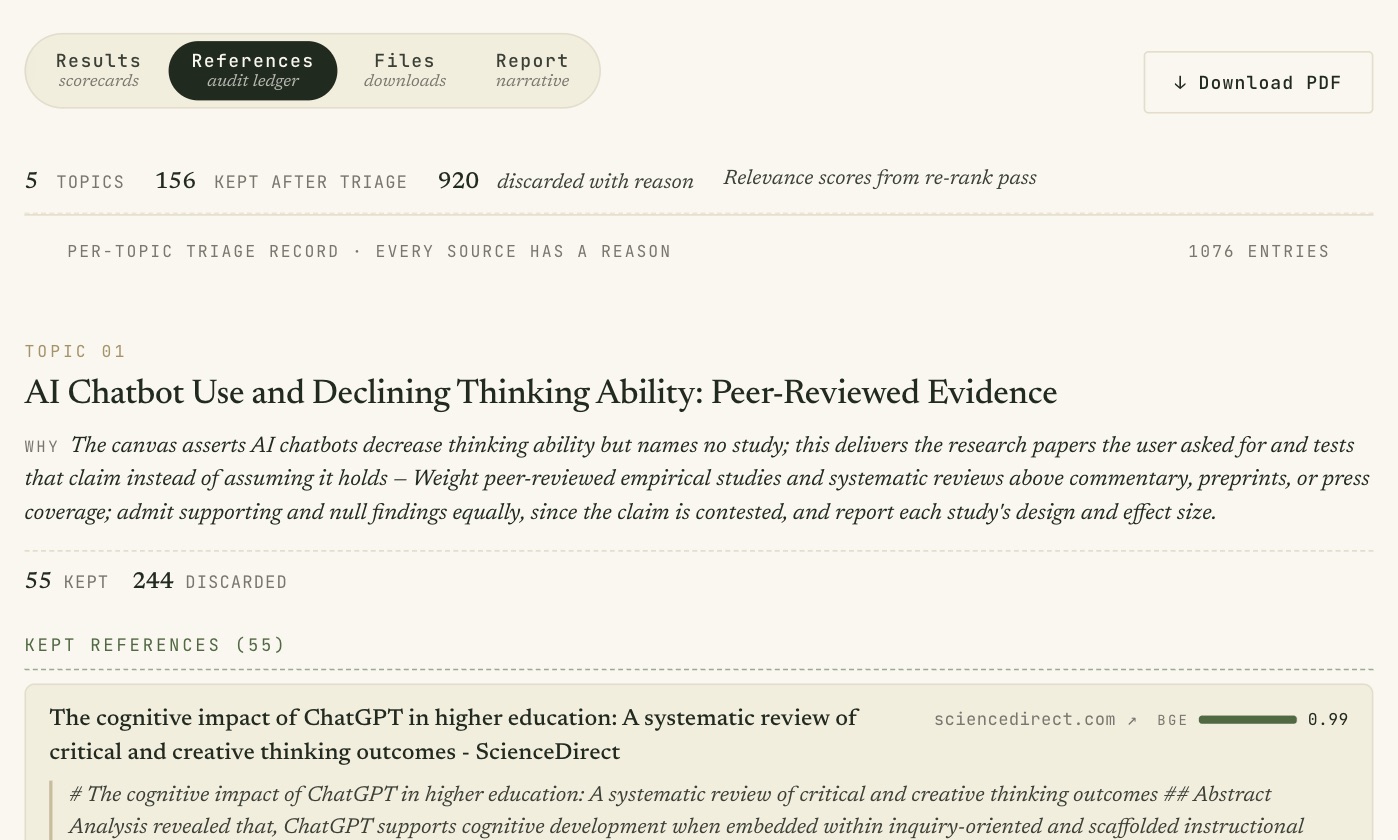
The report is a separate step that you start. Its citation numbers match the list, so you can trace a claim back to its source and open it. More: AI Grounding.
We gathered many of the sources for the evidence with it: under five topics it screened more than a thousand candidates, discarded 920 with a stated reason and kept 156. We then checked every source that article cites against its original paper.
The canvas: every step stays where you can see it
The problem. A chat moves in one direction. The reasoning scrolls away, and changing one early step usually means redoing everything after it. Authorship blurs too. In a peer-reviewed experiment, one week after mixing their own ideas with a chatbot’s, many people could not say which ideas had been theirs.5
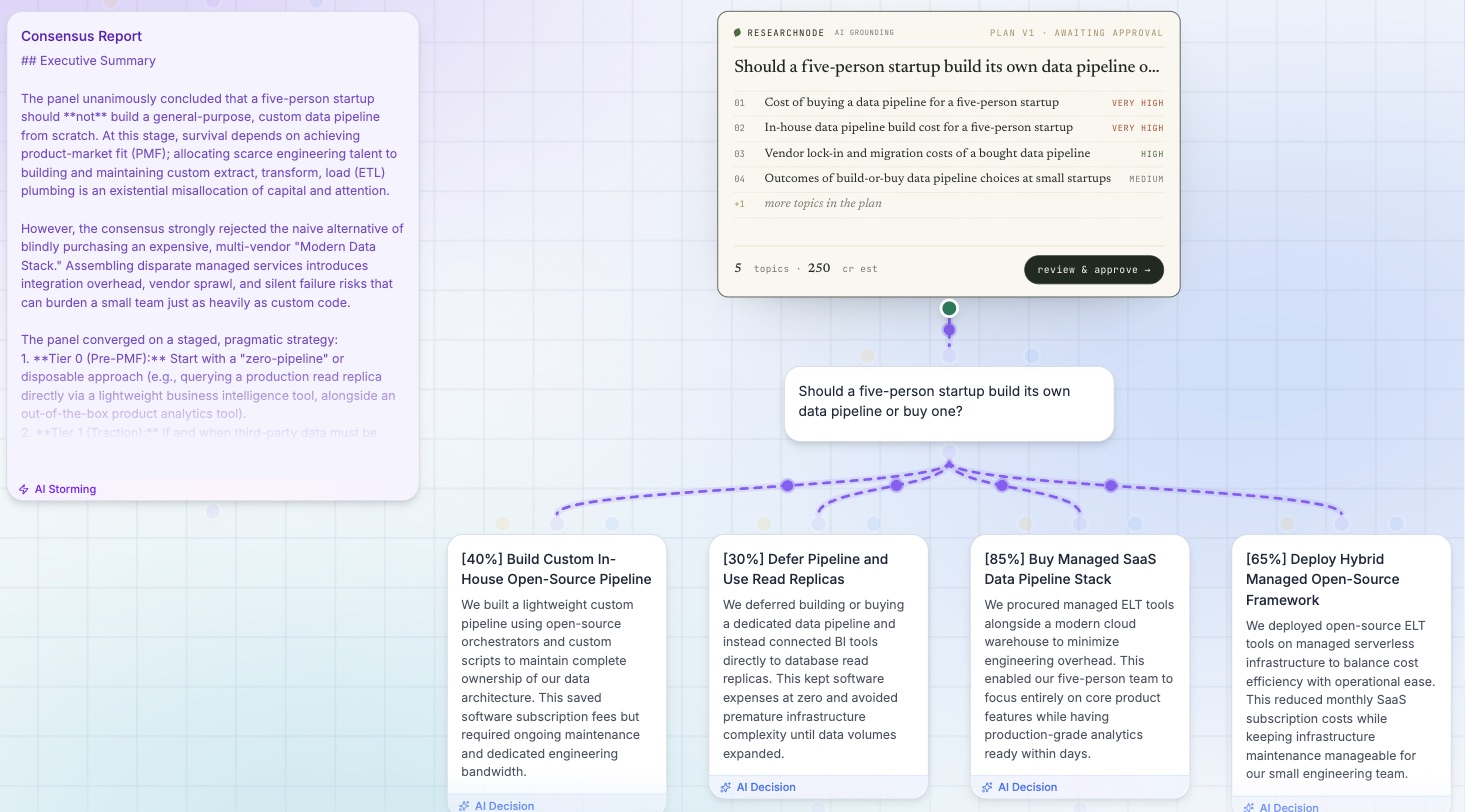
What Nodalist does. Chat is linear. Reasoning is not. In Nodalist, each step of your thinking is a node on a canvas. You can question it, edit it, branch from it or run the AI again from it, and undo what you don’t like. The AI works on the node you pick: break it down, weigh a decision or generate alternatives. If your request is unclear, it can stop and ask you a question on the canvas, and it builds only after you answer.
Each step waits for you. The AI runs when you press its button, a Storming session stops after every round, and Grounding searches only after you approve its plan.
Nodes the AI wrote carry a small label that says so, such as “AI Breakdown” or “AI Decision”. A Storming report arrives marked “AI Storming”. No study has tested Nodalist’s label, and we don’t claim it closes that gap. We built it because you should be able to see, at a glance, which parts of the map started with you.
“Where AI shows you its reasoning during a task and then moves on without asking for your approval, in Nodalist you can see and evaluate every stage of your work, go back and work on it again.”
When AI tells you it can’t be done
This section is my own experience, not a research finding.
The problem. On hard work, AI can take the easy road. It can tell you something is impossible when it has not done the work to find out.
What happened. While I was building Nodalist, AI tools told me again and again that a WebGL canvas (a way of drawing the whole workspace on the computer’s graphics chip, so it stays fast) was not possible, and that the performance problems would not be solved. I took the risk and tried anyway. A test build ran 800 nodes at 58 frames per second in Safari, which showed it can be done. It is still a test build and has not yet replaced the canvas in the live app.
“Unfortunately, in some situations that take a lot of work, AI can get lazy and point you the wrong way, whereas in AI Storming these situations come to light very easily.”
Why several models help here, in my view. When one model says “it can’t be done” and another lays out how it might be, you have a disagreement on your screen, and a reason to check before you give up.
Frequently asked questions
How is this different from asking ChatGPT?
ChatGPT is one of the models inside AI Storming, so the difference is not the model. It is the setup. Several models answer and challenge each other where you can see it. AI Grounding shows the sources it kept and discarded, with its reasons. And every step sits on a canvas you can edit and come back to.
Which AI models does AI Storming use?
Gemini (Google), ChatGPT (OpenAI), Claude (Anthropic), Grok (xAI), Kimi (Moonshot AI) and DeepSeek. Each comes in a Fast tier and a deeper Pro tier, and you choose which ones join a session.
Can I check the sources AI Grounding uses?
Yes. Every source in the kept and discarded lists has a link you can open, next to the reason it was kept or set aside. You can print the whole record or save it as a PDF.
Do I need to know how to code?
No. Nodalist runs in your web browser. You write your thinking into nodes and use buttons to run the AI.
Is there a free plan?
Yes. The Free plan includes 250 credits a month, 5 workspaces, AI Storming with all six models and one AI Grounding session a day. No credit card is needed. File upload comes with the paid plans.
References
- 1. Bastani, H., Bastani, O., Sungu, A., Ge, H., Kabakcı, Ö., & Mariman, R. 2025. “Generative AI without guardrails can harm learning: Evidence from high school mathematics.” PNAS 122(26): e2422633122. Peer-reviewed (correction 10.1073/pnas.2518204122 fixes an affiliation only). https://doi.org/10.1073/pnas.2422633122
- 2. Shaw, S. D., & Nave, G. 2026. “Thinking—Fast, Slow, and Artificial: How AI is Reshaping Human Reasoning and the Rise of Cognitive Surrender.” PsyArXiv yk25n_v1 (also SSRN 6097646). Preprint. https://doi.org/10.31234/osf.io/yk25n_v1
- 3. Fan, M., & Chang, P. 2026. “Telling Students to Evaluate Does Not Make It Happen: Task Stage, Offloading Tendency, and Error Detection in AI-Assisted Student Writing.” Behavioral Sciences 16(9): 1671. Peer-reviewed. https://doi.org/10.3390/bs16091671
- 4. Ding, H., Shen, Y., Chen, J., & Wang, P. 2026. “More vs. less cognitive offloading from AI assistants: impacts on novices’ collaborative performance and skill development.” Information Processing & Management 64(1): 105046. Peer-reviewed. https://doi.org/10.1016/j.ipm.2026.105046
- 5. Zindulka, T., Goller, S., Fernandes, D., Welsch, R., & Buschek, D. 2026. “The AI Memory Gap: Users Misremember What They Created With AI or Without.” Proceedings of CHI ’26, pp. 1–22. Peer-reviewed conference paper. https://doi.org/10.1145/3772318.3791494
The models argue. The sources are on the table. The decision is yours.